Sports Injury Recovery: Why “Rest Until It Stops Hurting” Is Not a Full Rehab Plan
Rest can calm symptoms, but returning to football, running or the gym usually requires rebuilding strength, speed, balance and confidence.

After a sports injury, rest can be useful in the early stage. Swelling may need to settle, a tissue may need protection, and some movements may be temporarily restricted. The mistake is assuming that absence of pain automatically means readiness for sport.
Football, running, basketball and gym training demand more than comfortable walking. They ask the body to accelerate, decelerate, absorb force, change direction and repeat those actions while tired.
Rehabilitation should rebuild the missing qualities
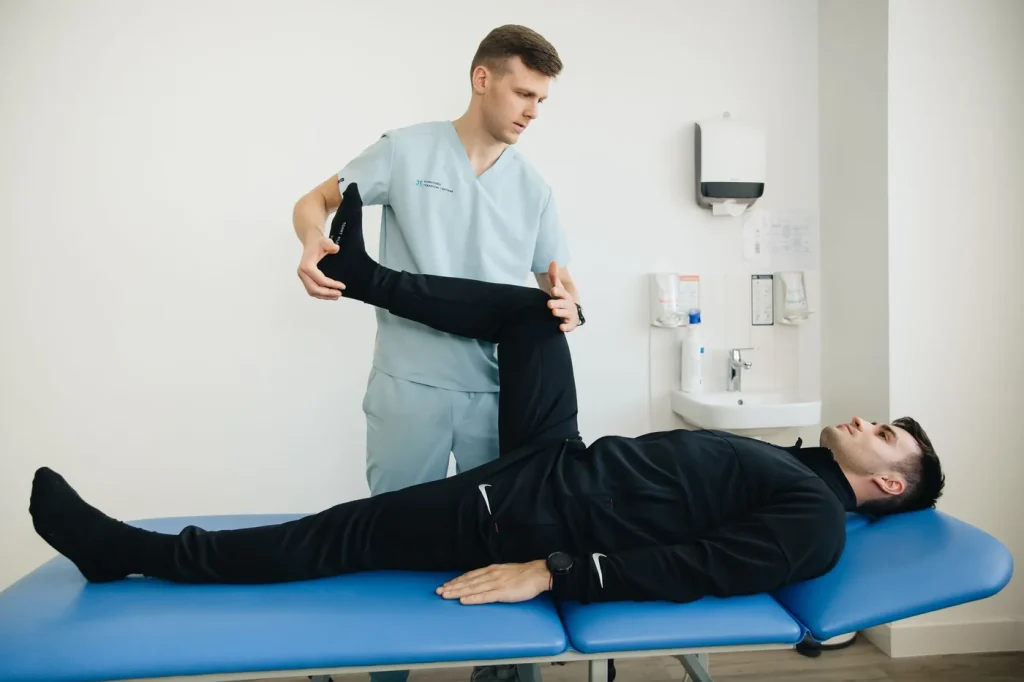
A good sports programme usually progresses through strength, range of motion, balance or control, power and sport-specific tasks. The exact sequence depends on the injury.
For an ankle injury, that might move from calf raises and balance work to hopping and changes of direction. After a hamstring problem, rehabilitation may progress from controlled strengthening to faster running. After a shoulder injury, a return to throwing or pressing needs more than pain-free rest.
Do not skip the “boring” middle phase
Early rehab feels obviously necessary because the injury is painful. Late rehab feels exciting because you are close to sport. The middle phase, where strength and workload are gradually rebuilt, is easy to rush. That is often the phase that prepares the body for what comes next.
Use criteria, not only a calendar
Time matters because tissue healing takes time, but a date alone does not tell you whether strength, control and confidence have returned. Depending on the injury, return-to-sport decisions may consider strength tests, hop tests, range of motion, repeated sprint tolerance, sport-specific drills and symptom response.
Build workload gradually
Going from no training to a full match or a heavy gym session creates a sudden workload spike. A staged return can start with individual drills, then controlled team training, then larger volumes and finally full competition.
Bottom line: rest can reduce symptoms. Rehabilitation prepares you for demand. If your goal is sport, the programme should eventually look like sport.
A simple example: returning to football
Being able to jog in a straight line is not the same as being ready for a match. Football adds acceleration, braking, cutting, contact, jumping, ball work and repeated high-speed efforts while tired. A return plan may therefore progress from comfortable running, to faster intervals, to planned direction changes, to reactive drills, to controlled training and finally to normal competition exposure.
The same logic applies to gym training. If your shoulder has been painful, being able to move the arm overhead without pain is only one step. The shoulder may still need strength and tolerance for repeated pressing, pulling or sport-specific loading.
Confidence deserves a place in the plan
After an injury, the body may test well while the athlete still hesitates during the movement that caused the problem. That hesitation is useful information. Gradual exposure to the feared task, starting in a controlled setting and increasing speed or unpredictability, can help rebuild confidence alongside physical capacity.
Return to sport should therefore answer two questions: can the body tolerate the demand, and does the athlete trust it enough to perform naturally?
Further reading
This article is general health education, not a diagnosis or a substitute for an individual clinical assessment. Seek urgent medical care for severe or rapidly worsening symptoms, major trauma, new weakness or numbness, loss of bladder or bowel control, chest pain, breathing difficulty, or other emergency symptoms.